

Ask ten people what agentic AI is and you shall hear eleven different definitions. Some see a digital employee that works autonomously, while others see a glorified chatbot with a few extra buttons. These are two extremes of the spectrum. To us, agentic AI means using AI to automate a step in a process. Nothing more, nothing less. That definition is small enough to start using it straight away, yet sufficiently broad to expand upon for years to come. Of course, a definition alone hardly covers everything. What is an agent from a technical perspective, what is it good at, and what not? This blog explains Quatronic’s vision.
Definition: what is an agent?
There are several definitions of agentic AI. Ours – using AI to automate a single step in a process – is intentionally succinct and brief. It does not depend on any technology as given datum, but rather starts with the existing business process.
Somewhere in that process is a step that cannot fully be automated using traditional methods because it requires reading, assessing, or articulating something. That is exactly where an AI agent fits well. Think of an incoming email that someone has to review in order to determine the subject, or a PDF invoice whose contents need to be entered into an ERP system. These are not strategic tasks; they are isolated steps between two systems where information changes form and where a human has always been required. Until now, that is.
The advantage of this definition is that one can quantify the costs or benefits of automation precisely. A single process step always has a measurable metric such as its duration or the number of times it can be performed per hour. This makes the discussion with the company much more natural than trying to make autonomous digital employees concrete would be.
However, many people view agentic AI as a virtual colleague that is assigned a task and then gets to work independently. Whilst such a usage is possible, one often obtains more value from automating one time-consuming step rather than an entire process. It is, after all, more manageable: the result is measurable, the business case clear, and implementation takes weeks rather than months.
The image of the digital colleague also has a psychological downside. It generates nervousness amongst employees (‘‘we're being replaced!’’) that seldom reflects reality. What the agent does, is remove a piece of work that no one enjoyed doing in the first place. That should be the frame, then. Do not start by asking which job an agent can take over, but rather which task employees perform a hundred times a week to the point of boredom.
What an agent can and cannot do
Actually to execute a step in a process, two things are required: an AI model – in practice, a (large) language model or LLM – and an action. That is precisely wherein lies the difference with ‘‘regular’’ AI.
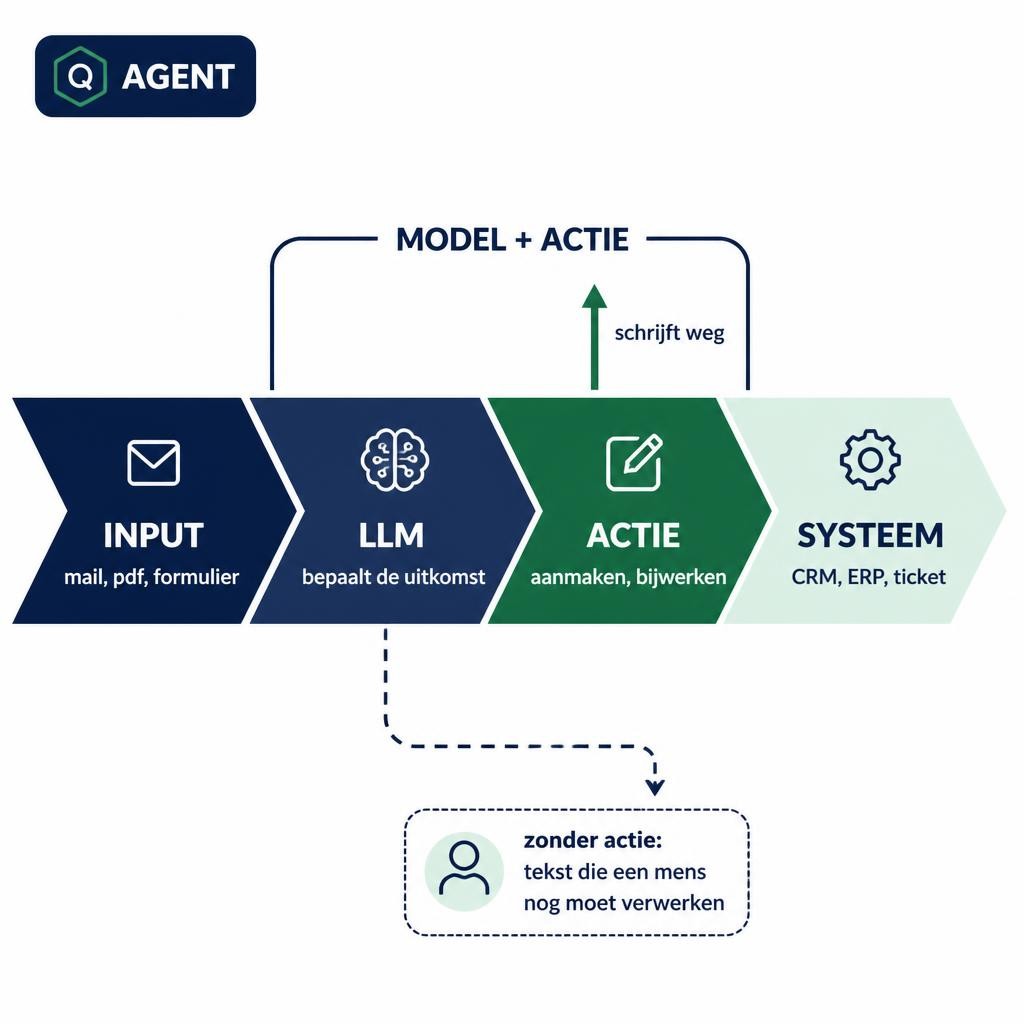
The model does the thinking. It reads the input, understands what it says, and determines what subsequently needs to happen. The action is the concrete step that follows: creating a customer service ticket, updating data, or placing an attachment in a document-management system, for example. The AI itself is usually the easy part, while the second side is where the real work is needed. Think of permissions, validations, and the question of what should happen if something should go wrong.
What justifies that extra effort? An AI agent excels at three things: interpretation, reasoning, and generation.
Interpretation is extracting meaning from input that is not neatly structured. An email, for example, a free text field in a form, or a scanned document. The agent determines what it is about and which data the input contains.
Reasoning is about making an assessment within established parameters. Does this fall within the warranty period? Is this an emergency? Is information missing, and if so, which? It is not about creative thinking, but about consistently applying predetermined rules to a situation the agent has not encountered in exactly this way before.
Generation ultimately entails the production ofoutput in the format required by the next system or person. A summary, a completed field, a draft response, a structured message, and so on.
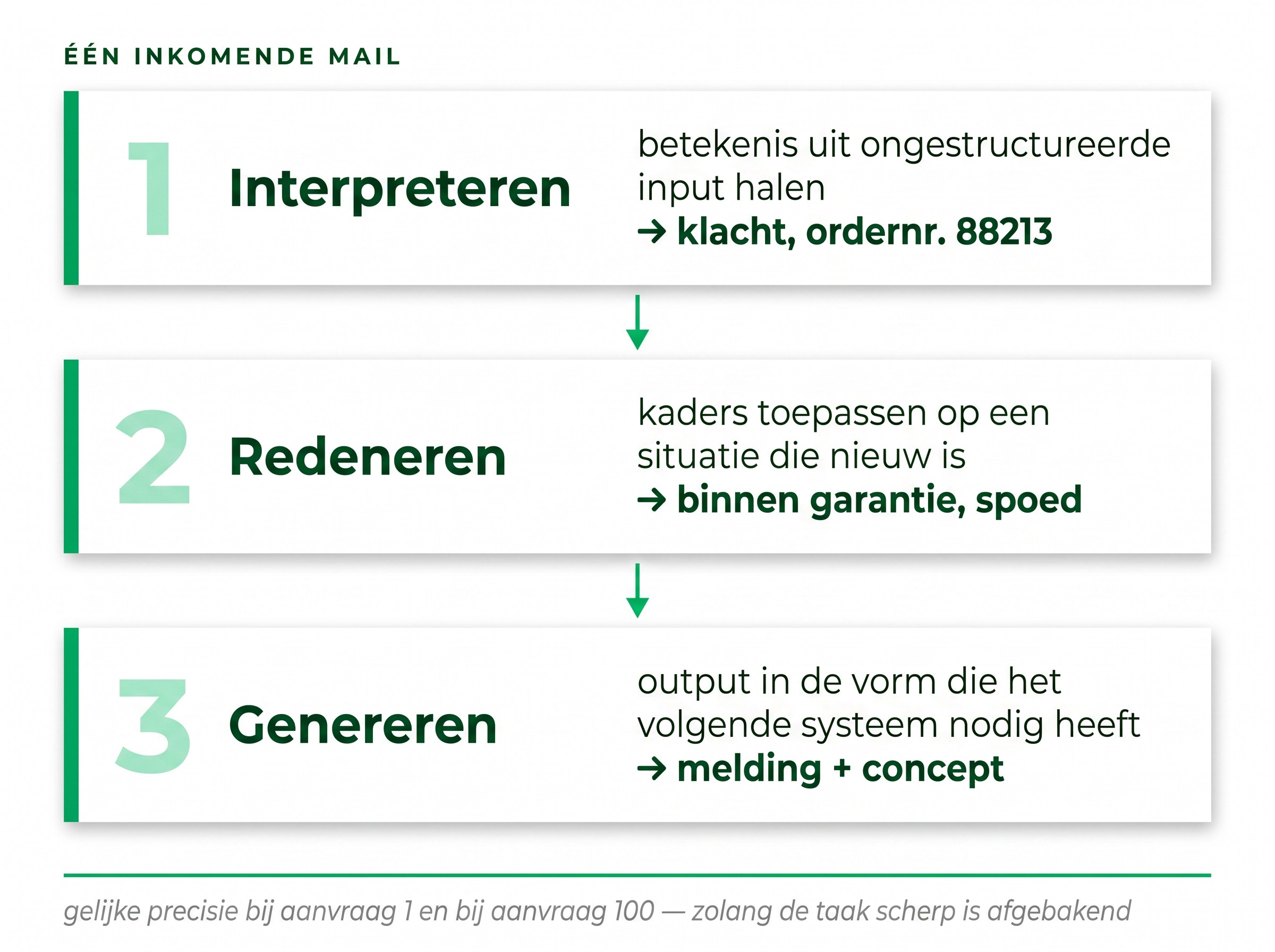
If you keep tasks simple and clear, an agent performs them just as well as a human and often even better. Especially when it comes to repetitive or tedious work, humans eventually start making mistakes. An AI agent, on the other hand, maintains the same level of precision on the hundredth request as it did on the first, without any lapse in attention.
However, that comparison only holds for clear, well-defined tasks. Give an agent an assignment with a vague description and ten exceptions and it will fail just as miserably as a new intern on his first day. The difference in results rarely depends on the model being used – it is about how clearly and sharply the task had been defined.
An agent can get to work anywhere
We can incorporate an agent into all kinds of existing platforms. All of these can employ a model, process a decision and execute an action in another system. That is good news, because it means the platform is hardly ever the limiting factor.
The real skill lies elsewhere: understanding a process. How are exceptions dealt with? Which step takes the most time? What happens when things go awry?
If all that is clear, building is simple. If not, then, regardless of the platform, you will build something that looks good in a demo but requires constant adjustment in production. That is also why we almost always start by examining the process at hand, not the tool to be used.
In both cases, we reiterate: write the instructions for the agent as though it were a new employee. Be clear, provide examples, note the exceptions, and state what should happen in case of failure. That document is the real construction work. The platform is merely where you place it.
A good start is half the battle
Agentic AI is emphatically not about transforming your entire business model. It is a way to remove steps from a process that no longer belong there. Here are our rules of thumb for getting started.
1. Choose a step, not a job function. Look for a task that occurs frequently and is prone to human error. There is your first agent.
2. Keep the scope small. One task, one output, one destination for the result. Multiple agents with smaller assignments are almost always better than a single agent with a large one.
3. Match the interface to the process. Use chat for exploration, a portal when a human initiates the task, and no interface at all when the process itself is the trigger.
4. Start with the process flow. Map out the process, solve what can be solved digitally, and assign an agent to the remaining steps.
By following these principles, we deliver something far more valuable than just a digital colleague: a flexible way to handle tasks in which nobody is interested, allowing your human team to focus on the work that truly matters.

Get in touch with
Auke

